Voyager view reveals Neptune, Triton and faint rings
A newly assembled scene uses Voyager 2 observations to look back at the distant planet, its largest moon and ring arcs.
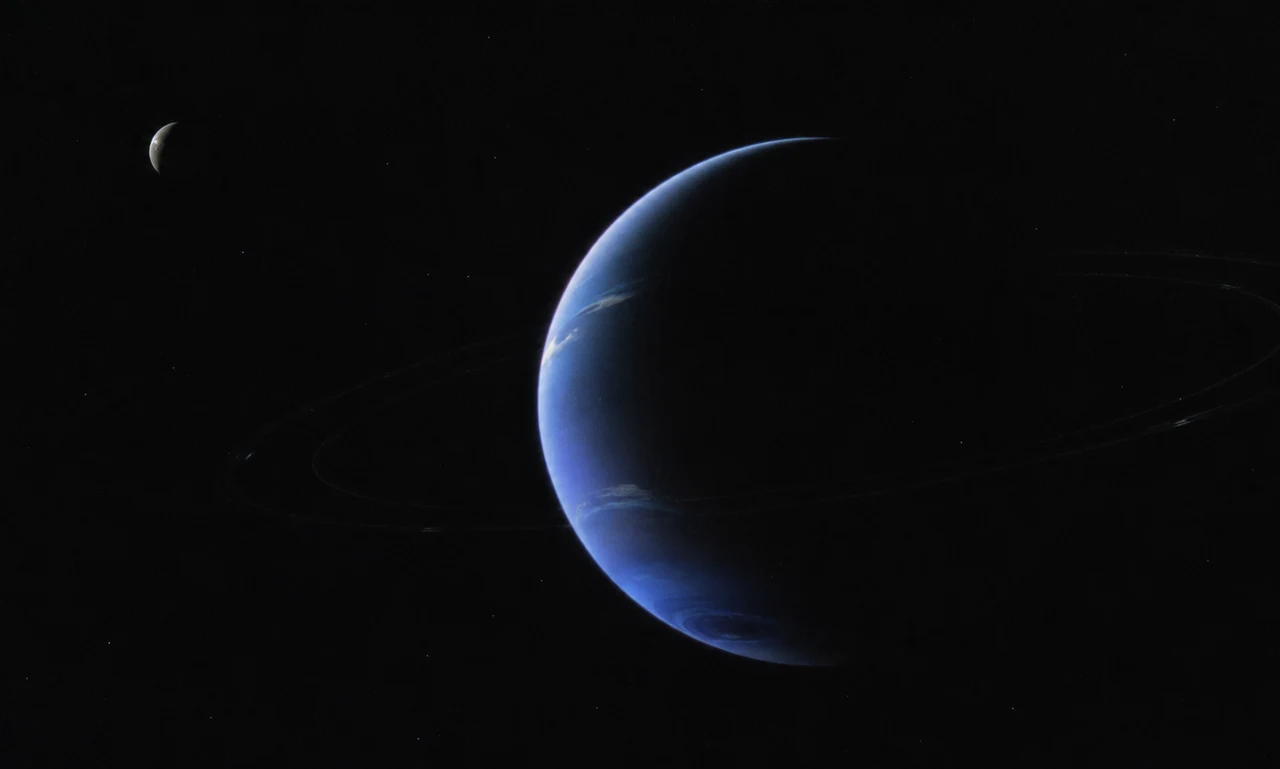
A newly assembled astronomical scene shows Neptune, its largest moon Triton and the planet's faint ring system from an outbound perspective.
The view is based on observations recorded by Voyager 2 during and after its August 25, 1989, encounter. Voyager 2 remains the only spacecraft to have visited Neptune.
Neptune and Triton appear as thin sunlit crescents when viewed from beyond the planet's orbit. Cirrus clouds and a dark band circle Neptune's south-polar region, with a cloudy vortex above the pole.
The composition includes the ring system and three bright ring arcs first seen during the flyby. Its 7.5-degree background starfield is centred on Camelopardalis, matching Voyager's outbound direction.
Voyager 2 is still operating in interstellar space in 2026, more than four decades after its launch.
Source
News brief based on the linked NASA feature.